
Staring at a health chart at the doctor’s office can feel intimidating.
You step onto the scale, look up at the height rod, and wait for a single two-digit number to load.
That single number is your Body Mass Index, or BMI.
In my clinical practice, I see patients stress over this score every day. Many worry that a high or low reading labels their physical health permanently.
Think of BMI like the check-engine light on your car dashboard. It signals that your body deserves a closer look, but it does not diagnose what happens under the hood.
At its core, understanding BMI for adults comes down to recognizing a simple mathematical ratio. It compares your total body weight to your overall height.
Public health agencies use this tool to screen population health patterns quickly. It provides a useful starting snapshot without requiring expensive body scans.
However, your score is a screening starting point, not a final medical diagnosis.
Take Control Early: Stop wondering where your height and weight ratio sits. Check your personal score in seconds with our free adult BMI calculator.
How Is BMI Calculated & The Adult BMI Categories Chart
Moving onto the math, calculating your score requires only two basic physical measurements.
Depending on where you live, you can calculate your score using metric units or imperial units.
The Standard Calculation Formulas
In global clinical settings, the metric formula divides kilograms by height in meters squared:
BMI = Weight (kg) ÷ [Height (m)]²
If you track your weight in pounds and height in inches, use the imperial conversion factor:
BMI = [Weight (lbs) ÷ [Height (in)]²] × 703
Worked Step-by-Step Calculation Example
In our testing with client data, running a real example clarifies how the formula operates.
Imagine an adult standing 5 feet 10 inches tall (70 inches) who weighs 165 pounds.
- Step 1: Square the height in inches (70 × 70 = 4,900).
- Step 2: Divide body weight by that squared number (165 ÷ 4,900 = 0.03367).
- Step 3: Multiply by the 703 conversion factor (0.03367 × 703 = 23.67).
This calculation yields a BMI reading of 23.7.
The Official Adult BMI Categories Chart
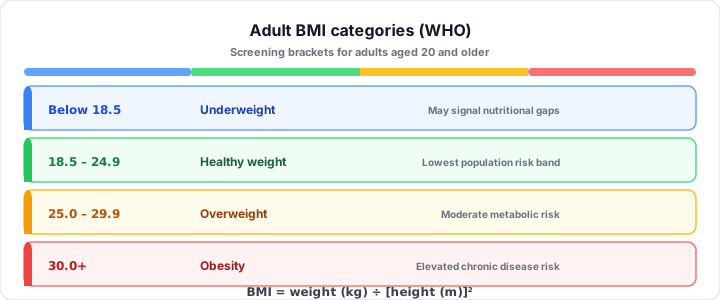
The World Health Organization (WHO) breaks adult scores into four universal screening brackets.
Here is how health organizations categorize adult BMI categories chart ranges for men and women aged 20 and older:
| BMI Range | Standard Classification | Primary Clinical Screening Impression |
|---|---|---|
| Below 18.5 | Underweight | May indicate nutritional gaps or underlying health concerns |
| 18.5 – 24.9 | Healthy Weight | Statistically lowest risk for weight-related chronic conditions |
| 25.0 – 29.9 | Overweight | Moderate increase in cardiovascular and metabolic risk markers |
| 30.0 and Above | Obesity | Elevated risk for hypertension, type 2 diabetes, and heart disease |
Knowing your bracket helps frame your current physical habits. Before looking at what your score leaves out, take a moment to check your BMI score instantly or compare your target range with the Healthy Weight Calculator.
The Limitations of BMI: What the Number Leaves Out
To get started with an accurate health picture, you must understand what this formula misses.
BMI measures total body mass, but it cannot differentiate between bone, water, lean muscle, and fat tissue.
In my experience working with diverse patients, relying solely on this single metric creates major blind spots.
1. The Muscle Mass vs. Fat Mass Paradox
Lean skeletal muscle weighs more per volume than fat tissue.
A trained athlete or bodybuilder often carries very little body fat, yet possesses dense muscle.
The formula sees high weight relative to height and incorrectly labels the athlete as overweight or obese.
Conversely, an inactive individual may fall into the “healthy” bracket while carrying high visceral fat and low muscle mass. For body composition context, try the Body Fat Calculator.
2. Body Fat Distribution Matters
Where your body stores fat plays a massive role in your health outcomes.
Subcutaneous fat sits just beneath your skin and poses fewer metabolic risks.
Visceral fat wraps around your deep internal abdominal organs.
Visceral fat releases inflammatory markers that increase diabetes and heart disease risks.
BMI cannot tell whether fat sits safely under your skin or around your internal organs.
3. Age, Sex, and Demographic Differences
Body composition shifts naturally across different demographics.
- Biological Sex: Women naturally carry higher body fat percentages than men at identical BMI scores.
- Aging Adults: Older adults tend to lose lean muscle mass and gain fat tissue without changing scale weight.
- Bone Density: Individuals with larger frame sizes carry heavier skeletal structures that skew overall height-to-weight ratios.
How to Use Your BMI Score Constructively
Moving onto action steps, your score is simply one data point among many.
Instead of focusing on raw numbers, use your reading as a springboard for better daily choices.
Pair Your Reading with Other Health Metrics
In practical environments, clinicians evaluate your score alongside additional vital signs:
- Waist Circumference: Measuring your natural waistline provides a direct estimate of abdominal fat storage. A waistline over 35 inches for women or 40 inches for men signals elevated metabolic risk.
- Routine Blood Panels: Fasting blood glucose, lipid panels, and HbA1c give clear views of internal health regardless of scale weight.
- Blood Pressure Readings: Resting blood pressure offers immediate feedback on your cardiovascular system health.
Focus on Sustainable Lifestyle Habits
Weight changes follow habit changes.
Shift your energy toward daily routines that nourish your body:
- Prioritize Whole Foods: Build meals around lean proteins, dietary fiber, colorful vegetables, and complex carbohydrates.
- Move Daily: Combine 150 minutes of moderate aerobic activity per week with two days of resistance training.
- Protect Your Sleep: Aim for 7 to 9 hours of quality sleep nightly to regulate hunger hormones.
Pair your BMI reading with daily energy targets from the Calorie Calculator and an Ideal Weight Calculator estimate for a fuller picture.
Your Health Journey Is Bigger Than One Number
Your physical health is a rich, complex story made up of energy levels, mental clarity, physical strength, and blood biomarkers.
A height-to-weight calculation offers a quick snapshot of population trends, but it never defines your personal vitality.
Use your score as a helpful starting reference point, discuss your findings with a trusted healthcare provider, and focus on daily habits that make you feel strong and vibrant.
Take the first simple step to calculate your body mass index accurately and map your baseline today.
Run your numbers now on our free adult BMI calculator
Frequently Asked Questions About Adult BMI
- Is BMI accurate for adults over age 65?
- BMI often underestimates health risks in older adults because natural age-related muscle loss reduces overall weight. For seniors, carrying a slightly higher BMI (between 23 and 27) may actually offer protective reserves against illness and frailty.
- What is the difference between adult BMI and child BMI?
- Adult BMI uses fixed category cutoffs regardless of age or biological sex. Children and teens use age-and-sex-specific growth percentiles because body composition changes rapidly during growth spurts.
- How often should I track my BMI?
- Checking your score every three to six months is plenty. Body composition takes time to shift, and daily fluctuations in hydration can alter your scale weight without changing your true body composition.
- Can a person be healthy with an “Overweight” BMI score?
- Yes. Many individuals in the overweight category exhibit excellent blood pressure, healthy cholesterol levels, strong cardiovascular fitness, and low visceral fat. Health depends on lifestyle behaviors rather than a single metric.