
Most people know they should save for retirement. Fewer know whether they are actually on track.
A vague goal like “save more” feels responsible but gives you nothing to measure. You need a number—how much you will have, how much you will need, and the gap between them.
Think of retirement planning like a road trip. You would not leave without checking the fuel gauge, estimating miles ahead, and knowing where you can refuel. A retirement savings calculator is that dashboard for your financial future.
In my work advising households on long-term planning, anxiety drops the moment people see a funded percentage instead of guessing. This guide walks through the inputs, formulas, and decisions that turn a calculator into a real plan.
Start with your numbers: Project savings at retirement, size the nest egg you need, and see whether you are funded. Run the scenario in our free Retirement Calculator.
What a Retirement Calculator Actually Tells You
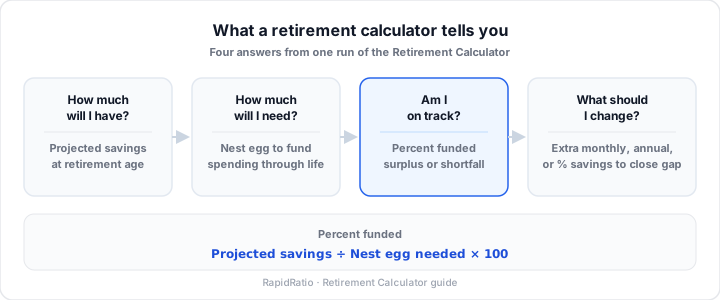
A good retirement calculator answers four questions in one pass:
- How much will I have? Projected savings at your planned retirement age.
- How much will I need? The nest egg required to fund spending through life expectancy.
- Am I on track? Percent funded and surplus or shortfall.
- What should I change? Extra monthly, annual, or percent-of-income savings to close a gap.
Without those four outputs, you are guessing. With them, you can decide whether to save more, retire later, or adjust spending expectations before it is too late to compound your way out.
The Core Inputs (and What to Enter)
Every retirement model starts with the same building blocks. Here is how to think about each field on the Retirement Calculator.
1. Ages: current, retirement, and life expectancy
Your current age and retirement age set how many years you have to save. Your life expectancy sets how long withdrawals must last.
If you are 35 and plan to retire at 65, you have 30 compounding years. If you expect to live to 90, the portfolio may need to support 25 years of withdrawals after you stop working.
2. Income and growth
Enter your current pre-tax income and an expected annual raise rate. Higher future income usually means higher savings if you contribute a percentage of pay.
3. Income needed after retirement
This is your replacement ratio—how much of today’s lifestyle you want in retirement. Many planners start at 70% to 80% of pre-retirement income.
You can enter this as a percentage of current income or a fixed dollar amount in today’s money. Mortgage payoff, lower commuting costs, and no payroll taxes often mean you need less than 100% replacement—but healthcare and travel can push needs back up.
4. Other income after retirement
Social Security, pensions, rental income, and part-time work reduce what your portfolio must cover. Estimate Social Security with our Social Security Calculator, then enter the monthly total here.
5. Current savings and contribution rate
Include 401(k), IRA, and taxable brokerage balances. Enter future savings as a percent of income or a fixed annual dollar amount. Model employer plans separately with the 401K Calculator if you want a deeper match breakdown.
6. Return and inflation assumptions
Investment return and inflation drive every long-range projection. Conservative households often use 5% to 7% nominal return and 2% to 3% inflation. Higher return assumptions make plans look easier; lower assumptions stress-test durability.
The Math Behind the Nest Egg
You do not need a spreadsheet to understand the logic. The calculator follows mainstream planner steps.
Step 1: Annual spending the portfolio must cover
Annual Portfolio Need ≈ (Replacement Rate × Projected Pre-Retirement Income) − Other Retirement Income
Example: at $90,000 pre-retirement income and 75% replacement, you target about $67,500 per year. If Social Security and pension pay $24,000 annually, the portfolio must cover roughly $43,500.
Step 2: Grow today’s savings forward
Current balance plus annual contributions compound at your return assumption until retirement. Starting early matters because each year of growth builds on the last.
Step 3: Convert spending need into a lump sum
The nest egg needed discounts recurring withdrawals from retirement through life expectancy, adjusted for inflation and investment returns. That lump sum is what you compare against projected savings.
Step 4: Percent funded
Percent Funded = Projected Savings at Retirement ÷ Nest Egg Needed × 100
Below 100% means a shortfall. The calculator then solves for extra monthly or annual savings to reach full funding by retirement age.
Worked Example: Are You on Track?
Suppose you are 40, plan to retire at 65, expect to live to 90, earn $85,000, and already have $120,000 saved. You contribute 10% of income, expect 6% returns and 2.5% inflation, and want 75% income replacement. Social Security might add $2,000 per month at retirement.
| Planning Input | Value |
|---|---|
| Years to save | 25 |
| Annual contribution (10% of $85k) | $8,500 |
| Income replacement target | 75% ($63,750/yr in today’s terms) |
| Other income (Social Security) | $24,000/yr |
| Portfolio income gap to cover | ~$39,750/yr (before inflation at retirement) |
Plug these numbers into the calculator and read Percent Funded. If you are at 82%, you are closer than most—but still short. The “Save Monthly” line shows exactly how much extra to set aside to hit 100% without guessing.
Run this scenario in the Retirement Calculator and adjust one lever at a time: retire at 67 instead of 65, raise savings to 12%, or trim replacement to 70%.
Five Levers That Move Your Plan the Most
- Start earlier. Every extra year of compounding reduces the burden on later contributions.
- Raise your savings rate before lifestyle creep locks it in. A 2-point increase at 35 beats a 10-point scramble at 55.
- Capture the full employer match. Model it with the 401K Calculator.
- Delay retirement slightly. Two extra working years both add contributions and shorten withdrawal years.
- Right-size replacement income. Honest spending targets prevent oversaving stress or dangerous undersaving.
Stack Your Accounts Strategically
Retirement funding rarely lives in one bucket. A typical stack:
- 401(k) or 403(b): Pre-tax growth plus employer match.
- Traditional or Roth IRA: Compare paths with the Roth IRA Calculator.
- Taxable brokerage: Flexible bridge before Social Security or RMD age.
- Pension or annuity: Fixed income that lowers portfolio pressure—see the Pension Calculator and Annuity Payout Calculator.
After age 73, required minimum distributions from tax-deferred accounts affect cash flow. Preview rules with the RMD Calculator.
Map Your Plan in Three Steps Today
- Gather balances across 401(k), IRA, and brokerage accounts.
- Estimate Social Security and any pension income at your planned retirement age.
- Run the Retirement Calculator, note percent funded, and write down the monthly savings gap if you are below 100%.
Revisit the plan after a raise, job change, or major life event. Retirement planning is a living document, not a one-time spreadsheet.
Calculate your nest egg and funding gap now
Frequently Asked Questions
- How much income do I need to replace in retirement?
- Most planners use 70% to 80% of pre-retirement income as a starting point. Housing costs often drop, but healthcare and travel can rise. Enter your target as a percentage or fixed dollar amount in today’s money.
- What does percent funded mean on a retirement calculator?
- Percent funded compares projected savings at retirement to the nest egg you need. Below 100% means a shortfall unless you save more, retire later, or reduce spending. Above 100% means a surplus.
- Should I include Social Security in my retirement plan?
- Yes. Enter expected monthly Social Security, pension, or rental income in Other Income After Retirement. That income reduces how much your portfolio must cover each year.
- What return rate should I use for retirement projections?
- Conservative planners often use 5% to 7% before inflation for a balanced portfolio, then subtract expected inflation for real-return thinking. Higher assumed returns make plans look easier but less reliable.