
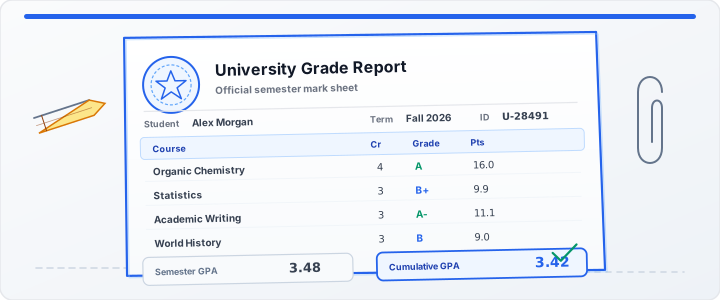
Seeing a grade lower than expected feels like a punch to the gut. I still remember opening my student portal sophomore year, staring at a 2.1 semester GPA, and feeling total panic. You start worrying about your financial aid, losing a scholarship, or getting rejected from graduate school.
Take a deep breath. A rough semester is just a temporary stumble, not a permanent record of your intelligence.
Your GPA is a dynamic moving average. When I rebuilt my own transcript, I realized that bouncing back requires a clear strategy rather than sheer panic. In this college GPA guide, I will walk you through the exact academic recovery college playbook to learn how to raise your college GPA fast.
Take Control Early: Stop guessing where your grades stand. Map out your target grades and see exactly what scores you need this term with our free college GPA calculator or the College GPA Calculator for semester-by-semester planning.
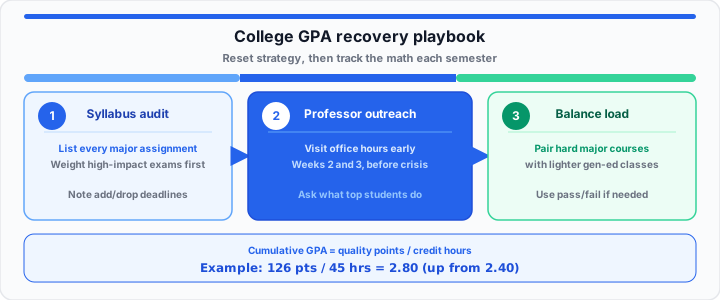
The Academic Recovery Strategy: 3 Steps to Reset Your Grades
Bouncing back takes deliberate execution. In my experience working with struggling students, working harder at broken study habits only leads to burnout. You need a targeted reset.
1. Conduct a Priority Syllabus Audit
Do not wait until midterm week to figure out where your standing hits trouble. Grab every syllabus right now.
- List every major assignment: Input every exam, paper, and project into one central master calendar.
- Calculate total grade weights: Identify the high-yield items. An exam worth 30% of your grade deserves five times more focus than weekly quizzes worth 2%.
- Track drop deadlines: Note your university’s add/drop and pass/fail cutoff dates immediately.
To make auditing easier, convert your target letter grades into standard quality points using this quick reference scale (or use our GPA to Letter Grade Calculator):
| Letter Grade | Standard Percentage | Quality Points (Per Credit Hour) |
|---|---|---|
| A / A+ | 93% – 100% | 4.0 |
| A− | 90% – 92% | 3.7 |
| B+ | 87% – 89% | 3.3 |
| B | 83% – 86% | 3.0 |
| B− | 80% – 82% | 2.7 |
| C+ | 77% – 79% | 2.3 |
| C | 73% – 76% | 2.0 |
| D | 60% – 69% | 1.0 |
| F | Below 60% | 0.0 |
2. Connect with Professors in Weeks Two and Three
Professors notice who shows up early. Walking into office hours before you have an academic crisis builds immediate credibility.
Keep the meeting brief and focused. Here are two questions I always recommend asking:
- “What study habits distinguish the top 10% of students in this course?”
- “Could I review my draft outline with you a week before the paper is due?”
This brief conversation shows initiative. When a professor decides whether to bump a 79.5% to an 80% at finals, that effort matters.
3. Balance Your Course Load Matrix
Avoid stacking four heavy reading or lab-intensive classes in a single semester.
Pair demanding upper-level major courses with lighter general education requirements. If a required course threatens your financial aid, consider switching it to pass/fail before the institutional deadline.
The Math of GPA Recovery: How Fast Can You Shift the Scale?
Think of your cumulative GPA like a heavy cargo ship. Moving it takes force, but the earlier you turn the wheel, the faster the ship responds.
The core calculation is straightforward:
Cumulative GPA = Total Quality Points Earned ÷ Total Attempted Credit Hours
Every completed class adds credit hours to your denominator. The fewer overall credit hours you have completed, the faster your average rises with good grades. For letter-to-point conversions, try the Letter Grade to GPA Calculator.
Worked Math Example: The Power of One Strategic Term
Let us look at a real recovery scenario. Suppose you entered this term with 30 credit hours and a 2.40 cumulative GPA.
- Starting Point: 30 credit hours × 2.40 GPA = 72 total quality points.
- Semester Action Plan: Take 15 credit hours this semester and earn a 3.60 term GPA (54 quality points).
- New Totals: (72 + 54) = 126 quality points divided by (30 + 15) = 45 total credit hours.
- New Cumulative GPA: 2.80.
| Semester Status | Total Credit Hours | Term GPA | Total Quality Points | Cumulative GPA |
|---|---|---|---|---|
| Before Recovery | 30 | 2.40 | 72.0 | 2.40 |
| Recovery Semester | 15 | 3.60 | 54.0 | — |
| After Recovery | 45 | 3.60 | 126.0 | 2.80 |
That is a massive 0.40 point increase in four months. You can easily estimate your target grades using the GPA Calculator or run semester scenarios with the College GPA Calculator to model your own recovery path.
4 High-Yield Daily Habits for Immediate Grade Bumps
You do not need 12-hour library marathons. In our testing with students, short and consistent routines produce better exam scores with less anxiety.
1. Ditch Highlighting for Active Recall
Re-reading notes and dragging a yellow marker across a page creates a false feeling of learning.
Instead, close your book and quiz yourself. Write out key formulas on a blank paper from memory, create digital flashcards, or teach a concept out loud to an empty room.
2. Practice Two-Pass Lecture Prep
Never walk into a lecture without pre-framing your brain.
Spend five minutes before class skimming chapter headings, bold terms, and diagram captions. This simple step creates mental hooks for new information.
During class, you will spend energy processing complex ideas rather than frantically copying down basic terminology.
3. Work in 25-Minute Study Sprints
Procrastination is usually caused by feeling overwhelmed, not laziness.
Set a timer for 25 minutes. Turn off phone notifications and focus on a single task until the chime sounds, then take a 5-minute break.
Four hyper-focused sprints accomplish far more than three hours of distracted multi-tasking.
4. Execute a 15-Minute Sunday Reset
Set aside 15 minutes every Sunday afternoon to review the upcoming week.
Check upcoming assignment deadlines, schedule specific study blocks on your calendar, and track your current assignment scores. Use the What-If Grade Calculator to see how upcoming finals and projects affect your course percentages.
Staying ahead of deadlines eliminates late penalties and prevents last-minute cramming panic.
Frequently Asked Questions About College GPA Recovery
- How many semesters does it take to raise a college GPA from 2.0 to 3.0?
- Moving from a 2.0 to a 3.0 typically takes two to four semesters of consistent B+ and A grades, depending on how many total credit hours you have already completed. The fewer total credits on your transcript, the faster your average rises.
- Does retaking a failed class replace the old grade?
- Most universities offer a grade replacement or course repeat policy where the higher grade replaces the lower grade in your cumulative GPA calculation. Check your school’s registrar guidelines, as both attempts usually remain visible on official transcripts.
- How do credit hours impact GPA math?
- Course credit hours act as multipliers in GPA calculations. A 4-credit lab science class has double the impact on your GPA compared to a 2-credit seminar, making high performance in heavy credit courses critical for fast recovery.
- Can I raise my GPA during my senior year?
- Yes, but the movement will be smaller because of your high volume of completed credit hours. Earning high grades in your senior year still demonstrates a strong upward academic trend to employers and graduate admissions committees.