
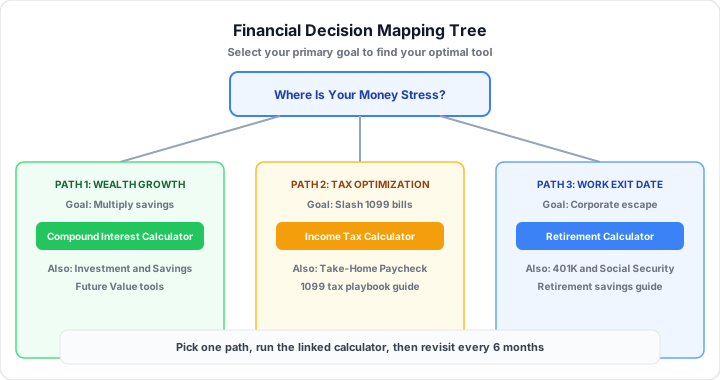
What keeps you up at night?
Is it unpaid freelancer taxes? Are you worried about delayed retirement? Maybe your savings grow too slowly. Stop guessing your financial future today. In my testing, guessing creates costly leaks. Pick your biggest money stress point below. You will find your exact path forward.
Quick picks: Compound Interest Calculator for growth · Income Tax Calculator for 1099 bills · Retirement Calculator for your escape date.
Stage 1: The Wealth Accelerator Pathway
Goal: I Want to Watch My Money Grow Faster
In my experience, uninvested cash dies slowly. Inflation shrinks your real purchasing power every month. Holding cash resembles parking ice in bright sun. The physical block melts down to nothing rapidly. You need a compounding engine working for you.
Compounding turns tiny deposits into massive wealth machines. Interest earns extra interest automatically over time. In our testing, early momentum beats starting capital size. Read the full breakdown in our Compound Interest Explained guide.
How the Compounding Engine Multiplies Wealth
Moving onto mechanics, let us look closely. First, you place a cash deposit seed down. Second, your yield rate adds bonus dollars. Third, time multiplies those bonus dollars repeatedly. Compound interest relies on a specific mathematical equation:
A = P(1 + r/n)nt
In this equation, A equals your total future balance. P represents your initial cash deposit seed. r equals your annual interest percentage rate. n represents annual compounding payout calculation frequency. t represents total investment timeframe in years.
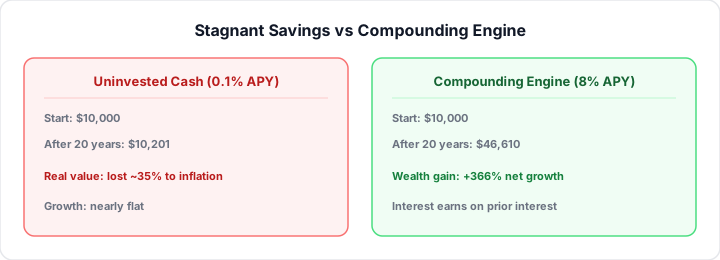
Compounding Frequency Return Multipliers
Daily compounding generates higher yield than annual compounding. Small compounding frequency shifts create noticeable cash differences. The table below shows growth on $10,000 over time:
| Compounding Interval | 10-Year Growth (7% Return) | 20-Year Growth (7% Return) | 30-Year Growth (7% Return) |
|---|---|---|---|
| Annual Frequency | $19,671 | $38,696 | $76,122 |
| Monthly Frequency | $20,096 | $40,387 | $81,164 |
| Daily Frequency | $20,135 | $40,542 | $81,623 |
Small adjustments to interest compounding create huge results. Run your exact numbers using our Compound Interest Calculator, Investment Calculator, or Savings Calculator.
Stage 2: The Tax Optimizer Pathway
Goal: I Want to Stop Overpaying the IRS
Freelancing brings immense personal schedule freedom daily. However, self-employment taxes surprise contractors every April. 1099 income lacks automatic employer tax withholdings. In my experience, surprise tax bills destroy small businesses.
You pay both employee and employer tax portions. That equals 15.3% in self-employment taxes alone. Social Security tax takes 12.4% of net earnings. Medicare tax claims an additional 2.9% portion. Do not let taxes drain your profit reserves. See our 1099 Tax Recovery & Planning Playbook for the full freelancer workflow.
Procedural Steps for 1099 Tax Estimates
To get started, follow these simple calculation steps:
- Sum your total gross contract revenue earnings.
- Subtract legitimate business software and gear expenses.
- Establish your net self-employment earnings baseline balance.
- Multiply net profit by 92.35% for taxable base.
- Apply the 15.3% self-employment tax rate.
- Subtract health insurance premiums and retirement write-offs.
| Income Bracket | Estimated Taxable Base | Average Quarterly Reserve | Estimated Annual Self-Employment Tax |
|---|---|---|---|
| $30,000 Net | $27,705 | $1,060 / quarter | $4,238 |
| $60,000 Net | $55,410 | $2,120 / quarter | $8,477 |
| $100,000 Net | $92,350 | $3,532 / quarter | $14,129 |
| $150,000 Net | $138,525 | $5,298 / quarter | $21,194 |
Track your business write-offs throughout the entire year. Save digital receipts for equipment, home office, and travel. Claim every write-off allowed under current tax regulations. Proper deductions reduce your net taxable income baseline. Estimate quarterly tax payments with our Income Tax Calculator or check net pay with the Take-Home Paycheck Calculator.
Stage 3: The Freedom Timeline Pathway
Goal: I Want My Corporate Escape Velocity Date
Retirement planning is not about hitting arbitrary ages. It is about hitting your true freedom number. Work becomes optional when investments cover living costs. In my testing, freedom timelines clear mental fatigue. You need clear milestones, not vague saving quotas.
Mapping Your Freedom Escape Velocity
Your escape date depends on four core metrics. Your annual living costs determine your baseline target. Multiply annual spending by 25 for safety margin. That calculation uses the proven 4% withdrawal rule. For example, $50,000 annual spending needs $1,250,000 capital. The formula reads:
Target Freedom Capital = Annual Expenses × 25
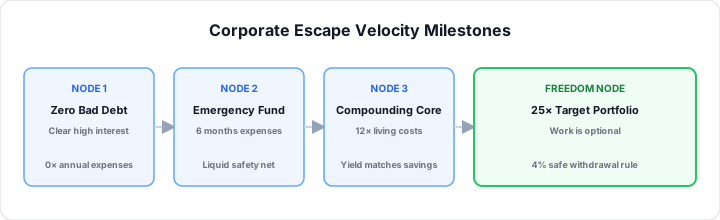
Freedom Escape Milestone Roadmap
In practical environments, track progress using defined portfolio stages:
| Freedom Milestone | Target Capital Ratio | Primary Strategic Action |
|---|---|---|
| Phase 1: Debt Zero | 0× Annual Expenses | Pay off non-mortgage consumer debts |
| Phase 2: Runway Core | 3× to 5× Annual Expenses | Build initial liquid index investment base |
| Phase 3: Halfway Mark | 12× Annual Expenses | Let investment yield match annual contributions |
| Phase 4: Full Freedom | 25× Annual Expenses | Transition corporate work into optional projects |
Map out your personal retirement timeline accurately today. Use our Retirement Calculator to project your exact escape date. Model employer plans with the 401K Calculator and estimate Social Security with the Social Security Calculator. For a deeper walkthrough, read the Ultimate Retirement Savings Calculator Guide.
Frequently Asked Questions
- Which financial calculator should I start with today?
- Start with the tool solving your biggest headache. Freelancers should estimate quarterly self-employment taxes first. Investors should analyze compounding interest rates next. Future retirees should calculate their retirement portfolio targets.
- Are these online financial calculators completely free?
- Yes, our online finance tools remain completely free. You do not need to register an account. We never ask for private personal banking details. Run unlimited financial scenarios anytime without hidden fees.
- How accurate are these free online calculation tools?
- In our testing, calculations match industry standard formulas. They reflect standard mathematical compounding and tax schedules. However, tax laws and market returns change over time. Use these numbers for strategic financial planning estimates.
- How often should I recalculate my financial projections?
- Recalculate numbers whenever your income changes significantly. Review compounding growth targets every six months. Adjust tax calculations at the end of each quarter. Update retirement targets during annual financial reviews.
- What is the best free financial calculator online for freelancers?
- Freelancers benefit most from combining two specific tools. First, calculate tax obligations with the Income Tax Calculator. Second, project long-term wealth with the Compound Interest Calculator. This combination protects current profits while building future capital.