
Money grows in two distinct ways. You can work hard for money. Or your money can work hard for you.
Compound interest is the engine behind true long-term wealth. Simply put, compound interest is interest earned on top of interest. When I analyze investor portfolios, the most successful individuals rely on this exact compounding mechanism rather than chasing risky market bets.
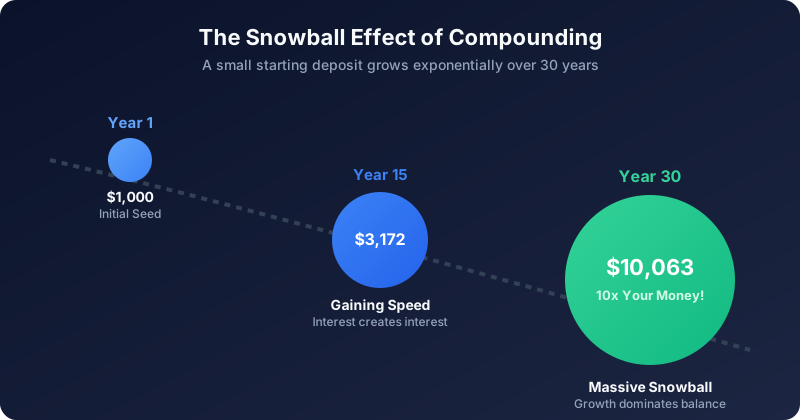
Think of it like a small snowball rolling down a steep, snow-covered hill. At first, the snowball gathers just a tiny dusting of snow. As it keeps rolling, its larger surface area picks up even more snow. By the time it reaches the bottom of the hill, that tiny snowball has transformed into a massive snow boulder.
Instant Wealth Simulation Tool: Want to see how fast your personal snowball can roll? Plug your savings rate into our free Compound Interest Calculator to project your net worth over the next 10, 20, or 30 years in seconds.
Simple Interest vs. Compound Interest: What Is the Difference?
To grasp why compounding is so effective, compare it directly with simple interest.
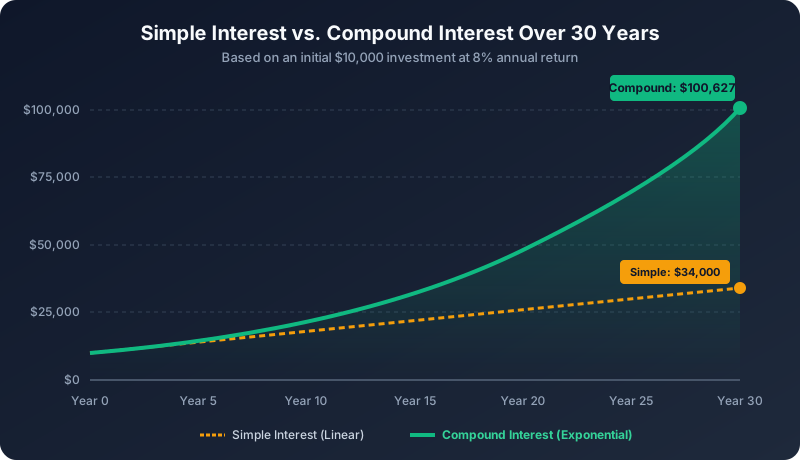
Simple interest pays returns strictly on your original principal. If you deposit $10,000 at an 8% simple interest rate, you earn exactly $800 every single year. After 30 years, you walk away with $34,000. Your growth line remains completely flat. Model this path with our Simple Interest Calculator.
Compound interest works on a snowball model. In year one, you earn $800 on your $10,000 principal, bringing your account to $10,800. In year two, you earn 8% on $10,800, which equals $864. You earn interest on your past interest. Over 30 years, that same $10,000 grows to over $100,000. Toggle between both modes on the Interest Calculator.
The 3 Fuel Factors That Make Compounding Explode
Compounding relies on three core financial levers. When you adjust these variables, your long-term wealth trajectory shifts dramatically.
- Principal (The Seed Money): This is the cash you contribute up front or through regular monthly deposits. Higher initial deposits give your compounding engine a larger base to build on immediately.
- Interest Rate (The Growth Rate): This is the annual percentage return your account generates. Even a small 1% or 2% bump in annual return can double your final payout over multi-decade spans. Solve for unknown rates with the Interest Rate Calculator.
- Time (The Ultimate Multiplier): Time is the single most effective ingredient in wealth building. The longer your money sits uninterrupted, the steeper the exponential growth curve becomes.
Mathematically, banks calculate compound interest using the classic formula:
A = P(1 + r/n)nt
In this formula, A represents your final balance, P is your starting principal, r is your annual interest rate, n is compounding frequency, and t represents total time in years.
Real-World Math: The Devastating Cost of Waiting
In my experience analyzing wealth building strategies, waiting to invest is far more costly than starting with small amounts early.
Let’s look at two investors, Alex and Sam. Both target an average annual return of 8%.
Alex starts at age 25. He invests $200 per month until he retires at age 65. Over 40 years, Alex contributes $96,000 out of his own pocket. Thanks to compound interest, his account balance reaches $622,000 by age 65.
Sam delays his investing journey. He waits until age 35 to start saving the exact same $200 per month. Over 30 years, Sam contributes $72,000. By age 65, Sam ends up with $272,000.
| Investor Metric | Alex (Early Starter) | Sam (Late Starter) |
|---|---|---|
| Starting Age | Age 25 | Age 35 |
| Monthly Deposit | $200 / month | $200 / month |
| Total Cash Invested | $96,000 | $72,000 |
| Final Balance at Age 65 | $622,000 | $272,000 |
| Total Growth Earned | $526,000 | $200,000 |
Sam contributed just $24,000 less than Alex out of pocket. Yet Sam ended up with $350,000 less in total wealth.
Those ten lost years cost Sam more than half his potential portfolio. You can easily simulate your compounding growth with the Investment Calculator or use the Savings Calculator to discover what a 5 or 10-year head start means for your target retirement age.
Frequently Asked Questions About Compound Interest
- How frequently does compound interest calculate in standard bank accounts?
- Interest can compound daily, monthly, quarterly, or annually depending on your financial institution. High-yield savings accounts typically calculate interest daily and credit it monthly. Frequent compounding yields slightly higher annual growth.
- What is the Rule of 72 and how do I use it?
- The Rule of 72 is a quick mental shortcut to estimate how many years it takes to double your money. Divide 72 by your expected annual rate of return. At an 8% return, your money doubles roughly every 9 years (72 ÷ 8 = 9).
- Can compound interest work against you?
- Yes. Compounding works in reverse when you carry high-interest debt, such as credit card balances. Unpaid interest gets added to your principal debt every month, making balance repayment progressively harder.
- How do I start compounding with small monthly deposits?
- Begin by setting up automated monthly transfers into a low-cost index fund or high-yield savings account. Consistency matters far more than starting big. Even $50 per month starts your exponential snowball rolling immediately.
Put Time to Work for Your Money Today
Time is your most powerful financial ally. You do not need thousands of dollars or complex stock-picking skills to build serious wealth over time. You simply need to get your money moving as soon as possible.
Take control of your financial future today. Use our interactive tool to calculate your long-term wealth projections and chart your personal path toward financial freedom!