
Opening your first 1099 form feels startling. You expected a clean deposit, then realized nobody withheld a dime for taxes.
When you work a standard job, your employer peels taxes off before your paycheck lands. Independent contracting flips that entirely. Every dollar clients pay you arrives raw—like buying an unpeeled orange. You cannot eat the whole thing until you remove the skin, which represents self-employment tax and income tax combined.
In my decade of CPA practice advising self-employed workers, tax anxiety stems from mystery, not math. Once you see where each dollar goes, independent contractor taxes US rules stop feeling like a trap and start looking like a checklist.
Take Control Early: Stop guessing how much of your revenue you actually keep. Run your bracket and quarterly obligations through our free US income tax calculator before the next deadline hits.
How to Use This 1099 Tax Playbook
To get started, treat this guide like a quarterly close for a one-person business—not a panic session on April 14.
- Gather every 1099-NEC and 1099-K you received, plus any income missing a form. The IRS still expects tax on money clients paid even when no slip arrived.
- List deductible business expenses with receipts: software, home office space, mileage, subcontractor payments, and health premiums if you qualify.
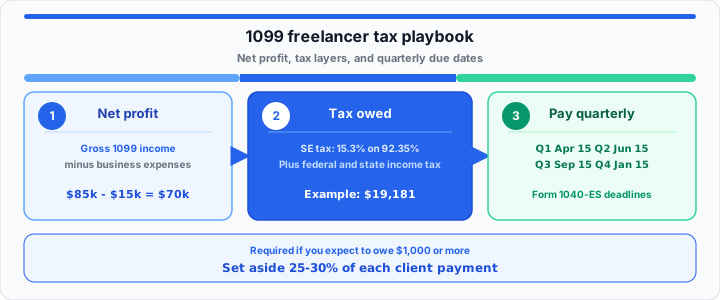
- Calculate net profit by subtracting expenses from gross 1099 revenue, then run the result through our Income Tax Calculator to split self-employment tax from federal and state income tax.
- Set aside 25 to 30% of each payment in a separate business savings account so quarterly deadlines never raid personal rent money.
- Pay Form 1040-ES installments on the IRS calendar below, or true up at filing if your liability stays under 1,000 dollars for the year.
In practical environments, a freelance brand designer who logs expenses weekly and pays estimated tax on net profit still has cash for a slow month—because she never treated gross deposits as spendable income.
1099 Tax Formulas and Practical Applications
Moving onto the math, the IRS treats you as both employer and employee. That dual role splits your bill into two buckets before state taxes enter the picture.
Self-Employment Tax (Social Security and Medicare)
W-2 workers split FICA taxes with their boss. You pay 7.65%, the employer pays 7.65%. On 1099 taxes, you sit on both sides of the desk—the full 15.3% lands on your net business earnings.
- Social Security: 12.4% on net earnings up to the annual wage base cap.
- Medicare: 2.9% on all net earnings, with an extra 0.9% surtax above higher income thresholds.
Federal and State Income Taxes
After self-employment tax, progressive federal income tax applies to remaining net profit, with most states adding another layer on top.
Net profit starts with gross client payments minus legitimate write-offs:
Net Taxable Business Income = Gross 1099 Revenue − Total Deductible Business Expenses
The IRS applies self-employment tax to 92.35% of that net figure—not the full amount:
Self-Employment Tax Base = Net Taxable Business Income × 0.9235
Self-Employment Tax Owed = Self-Employment Tax Base × 0.153
You may also deduct 50% of self-employment tax when calculating adjusted gross income, which trims the income-tax layer slightly. Model both layers together in the Income Tax Calculator or compare W-2 vs 1099 take-home with the Take Home Paycheck Calculator.
Worked Example: 85,000 Dollars Gross, 15,000 in Expenses
- Gross client payments: 85,000
- Eligible deductions: −15,000
- Net business profit: 70,000
| Tax Tier Component | Rate / Bracket Basis | Estimated Amount Owed |
|---|---|---|
| Gross Business Revenue | Base client payments | $85,000 |
| Deductible Operating Expenses | Valid business write-offs | −$15,000 |
| Net Taxable Business Profit | Taxable business base | $70,000 |
| Self-Employment Tax (SE Tax) | 15.3% applied to 92.35% of net profit | $9,891 |
| Federal Income Tax (Estimated) | Single filer standard deduction applied | $6,140 |
| State Income Tax (Estimated) | Average state income tax rate (~4.5%) | $3,150 |
| Total Combined Tax Obligation | Effective tax rate (~27.4% of net profit) | $19,181 |
The IRS Estimated Tax Calendar for Freelancers
The US tax code runs on a pay-as-you-go system. If you expect to owe 1,000 dollars or more after credits and withholding, the IRS expects four quarterly payments via Form 1040-ES—waiting until spring filing triggers underpayment interest.
Mark these deadlines every year (dates shift to the next business day when they land on a weekend or holiday):
| Tax Quarter | Income Earned Window | IRS Payment Due Date |
|---|---|---|
| Quarter 1 | January 1 – March 31 | April 15 |
| Quarter 2 | April 1 – May 31 | June 15 |
| Quarter 3 | June 1 – August 31 | September 15 |
| Quarter 4 | September 1 – December 31 | January 15 (Following Year) |
Note: If an IRS payment deadline falls on a weekend or federal holiday, the official due date automatically shifts to the next business day.
Five Deductions That Shrink Your 1099 Tax Bill
Every legitimate business expense lowers net profit dollar-for-dollar, which cuts both self-employment tax and income tax. In my experience, contractors who log expenses weekly—not at year-end—catch thousands in write-offs they would otherwise forget.
Simplified Home Office
A room used exclusively for work qualifies for the simplified deduction: 5 dollars per square foot up to 300 square feet (1,500 dollars max) without tallying utility bills.
Software and Digital Tools
Subscriptions required to deliver client work are fully deductible—design apps, cloud storage, invoicing, CRM, domains, and VPN access.
Phone and Internet Split
If 60 percent of your phone and home internet use supports client work, you write off 60 percent of those annual bills.
Marketing and Subcontractors
Ads, portfolio sites, business cards, and payments to subcontractors who help deliver client projects all reduce net profit.
Self-Employed Health Insurance
Without access to a spouse’s employer plan, premiums you pay for your own medical coverage can lower adjusted gross income on Form 1040.
In practical environments, keeping receipts in one folder beats reconstructing twelve months from bank statements. Before your next quarterly payment, calculate your self-employment tax burden with deductions applied, or pair this playbook with our Financial Freedom Blueprint if taxes are only one piece of your money stress.
Frequently Asked Questions About US Independent Contractor Taxes
- What happens if I miss a quarterly estimated tax deadline?
- Pay as soon as you can. The IRS charges annualized interest on late estimated payments, so each day you wait adds cost. A late payment still beats no payment.
- Do I have to pay quarterly taxes if I earn under $1,000 net income?
- If your total tax liability after credits and withholding stays under 1,000 dollars for the year, you can skip quarterly estimated payments and settle the balance at filing time.
- What percentage of incoming payments should I save for taxes?
- In my CPA practice, I tell clients to set aside 25 to 30 percent of every deposit in a dedicated business savings account. That buffer covers federal, state, and self-employment layers without touching rent money.
- How does Form 1099-NEC differ from Form 1099-K?
- Clients send Form 1099-NEC when they pay you 600 dollars or more by check or direct transfer. Payment processors issue Form 1099-K for card and platform transactions they handled on your behalf.
- Can I deduct part of my self-employment tax on my return?
- Yes. You can deduct 50 percent of self-employment tax when calculating adjusted gross income on Form 1040. The full 15.3 percent still applies to net profit first, but the adjustment lowers the income-tax layer.